
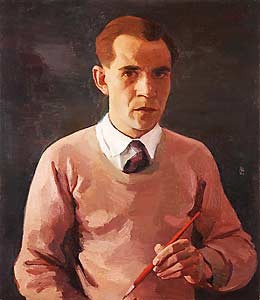
Karl Hauk (1898-1974)
Karl Hauk was born the second son of a pharmacist on May 1st, 1898 in Klosterneuburg near Vienna. In 1904, the family moved from Vienna to Linz, where Hauk grew up in upper middle class conditions. After finishing school in Linz, he started to study at the Technische Hochschule/Technical College of Vienna, but was called to war service in Italy in 1916.
After the war, Hauk registered at the Academy of Fine Arts in Vienna where Sterrer, Jungwirth and Delug were his teachers. As early as 1920, he took part in an exhibition of the artist association “Der Ring” in Linz. In 1921, he obtained an academy-award – in the same year, he presented his work in Vienna for the first time at the autumn exhibition of the Secession.
From 1923, Hauk worked as a freelance artist in Linz and Vienna. He exhibited his work again at the Secession as well as at the Hagenbund-artist association (in 1927 he became a Hagenbund member). Hauk’s versatile activities in the inter-war years contain in particular works in public space. One of the most prestigious charges was the covering of the assembly hall walls of the Upper Austrian Arbeiterkammer in Linz. Painted in 1928, the frescoes were destroyed by fire in the Second World War. The same happened to Hauk’s décor of the central railway station hall in Linz.
From 1933, Hauk predominantly lived in Vienna and focused on religious art. Amongst others he decorated the parish church Sandleiten in Vienna and designed the glass paintings in the Christkönigskirche. Hauk was friends with the architect Clemens Holzmeister and participated in the decoration of some of his buildings.
Hauk’s monumental figurative style used in the pre-war religious paintings corresponded with the aesthetic preferences of the Nazi regime. From 1938, he continued his work without facing suppressions, however in 1943 he was again called to military service.
After the war, Hauk exhibited successfully as early as December 1945, and he was appointed director of the newly founded Art School, Linz. He continued working as an artist until the 1960's and travelled to foreign countries during that time. From 1951, he lived mostly in Vienna, where the reconstruction offered him numerous activities, such as the decoration of the service hall of the Wiener Städtische Versicherung and of many residential neighbourhoods.
During the 1970's, Hauk, who died on August 13th 1974 in Vienna, slowly fell into oblivion. The present revaluation of inter-war art spotlights him again. Kunsthandel Widder (Widder Fine Arts) is in charge of the majority of the artist’s estate. Hauk’s work is also owned by the Albertina, the Wien Museum and the Upper Austrian State Museum, whose exhibition “Neue Sachlichkeit in Oberösterreich” recognized Hauk as an important representative of Austrian modernism.


